
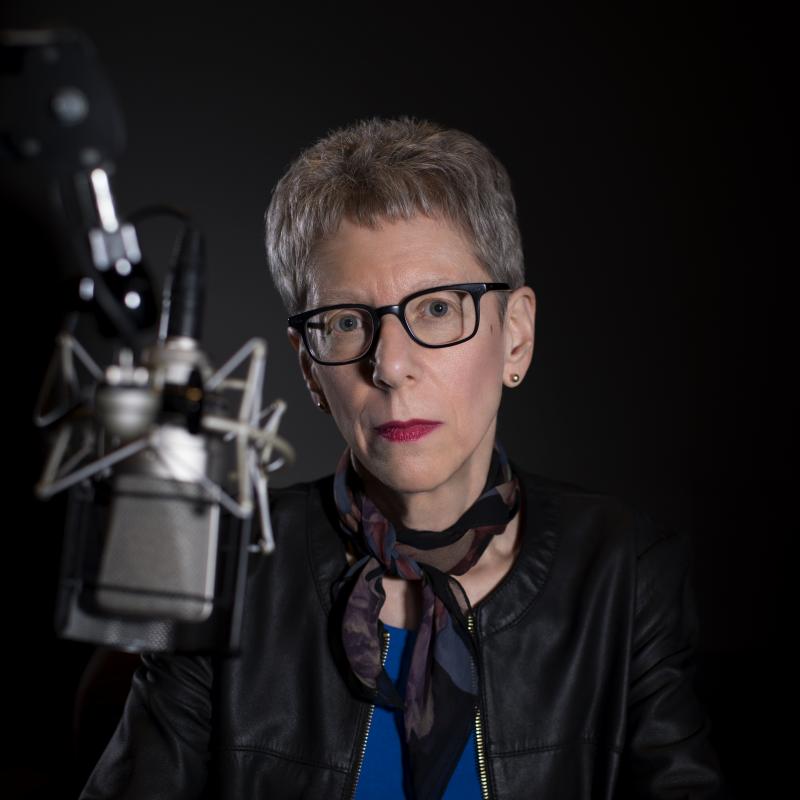
Terry Gross at her microphone in 2018

Terry Gross

Terry Gross is the host and an executive producer of Fresh Air, the daily program of interviews and reviews. It is produced at WHYY in Philadelphia, where Gross began hosting the show in 1975, when it was broadcast only locally. She was awarded a National Humanities Medal from President Obama in 2016. Fresh Air with Terry Gross received a Peabody Award in 1994 for its “probing questions, revelatory interviews and unusual insight.” America Women in Radio and Television presented her with a Gracie Award in 1999 in the category of National Network Radio Personality. In 2003, she received the Corporation for Public Broadcasting’s Edward R. Murrow Award for her “outstanding contributions to public radio” and for advancing the “growth, quality and positive image of radio.” Gross is the author of All I Did Was Ask: Conversations with Writers, Actors, Musicians and Artists, published by Hyperion in 2004. She was born and raised in Brooklyn, NY, and received a bachelor’s degree in English and M.Ed. in communications from the State University of New York at Buffalo. She began her radio career in 1973 at public radio station WBFO in Buffalo, NY.

Sort:

Newest

24:18

New York City Transit Police Officer Brendan McGarry Discusses Panhandlers.

New York City transit police officer Brendan McGarry. He's been at the job for 21 years. McGarry wrote (also in a recent New York Times article, 10 Apr 94) about the homeless and the panhandlers on the subways, "for a transit cop, they are a tough, unpleasant, sometimes dangerous part of a sometimes thankless job." McGarry complains the public misunderstands them and accuses them of mistreatment. But he says they've worked hard at finding shelter and services for the subway's homeless, setting up a homeless outreach unit.

Interview
21:59

Antibiotic Resistant Bacteria.

Dr. Stuart Levy is a professor at Tufts University Medical School, and has just written a book, "The Antibiotic Paradox: How Miracle Drugs Are Destroying the Miracle," (Plenum). This book looks at the threat of antibiotic-resistant bacteria that are resulting from over-prescription of antibiotics. Dr. Levy is recognized internationally as an expert on resistance and as a critic of the widespread misuse of antibiotics. He is also president of the International Alliance for Prudent Use of Antibiotics.

Interview
16:22

Politician Stewart Udall Discusses Nuclear Weapons.

Stewart Udall served three terms in Congress, and as Secretary of the Interior under Presidents Kennedy and Johnson. He is the author of a new book, "The Myths of August", (Pantheon) which chronicles his struggle as one of the first lawyers to represent thousands of Americans who were injured or killed by the testing of atomic weapons. Udall spent years investigating and litigating cases filed by Southwestern families who had been harmed by atmospheric testing of atomic bombs, and by families of Navajo men who developed lung cancer after mining Uranium for the Government.

Interview
45:44

From the Archives: Milos Forman Discusses His Life and Career.

Film director Milos Forman. Originally from Czechoslovakia, Forman is the director of such American films as "One Flew Over the Cuckoo's Nest," "Amadeus," "Hair," and "Ragtime." Forman began his film career in his native country, apprenticing with some of the country's best film makers for the Communist state-controlled film industry.

Interview
22:39

The Roe of Roe v. Wade.

Norma McCorvey. She was the plaintiff in Roe vs. Wade. In the lawsuit she was called Jane Roe to shield her privacy. In her new book "I Am Roe" (Harper Collins), she tells her story. She was poor, alone and pregnant. Her case became a landmark Supreme Court decision--it gave women the right to choose abortion. But McCorvey ended up giving birth to the child because the Supreme Court decision came too late.

Interview
23:01

Pennsylvania Governor Robert P. Casey.

Pennsylvania Governor Robert P. Casey. June 14th will be the first anniversary of his "return from the dead." Last year when he was close to death from a fatal liver disease that was destroying his heart, Casey received a heart and liver transplant. The donor was a young African American man who was savagely beaten by drug dealers. Casey talks about his second chance at life. And he discusses his views--pre and post-surgery--on political issues of life and death such as abortion and the death penalty.

Interview
22:23

E-Mail and Flames.

Terry talks with New Yorker writer John Seabrook about the downside of electronic mail. Then she gets a response from Stewart Brand, the inventor of The Well, a computer conference system. . . Last January Seabrook wrote an article in the New Yorker magazine about Microsoft chairman, Bill Gates. Seabrook was flooded with electronic mail as a result, and to his surprise he was "flamed" for the first time. In Internet jargon, to be "flamed" is to receive an obscene or derogatory E-mail message. Seabrook said he'd never received anything like it before.

15:27

Life After Being Struck By Lightning.

Writer and former film maker Gretel Ehrlich is the author of "The Solace of Open Spaces," a collection of essays about life on Wyoming's high plains. It was while walking on the Wyoming plains, that Ehlrich was struck by lightning. The force of it threw her forty feet, severely damaged part of her nervous system, and sent her into a "solitary limbo." Ehrlich returned to her parents home for medical treatment and began trying to understand what happened to her.

Interview
13:35

Feminist, Iconoclast, and Angry Black Woman Julianne Malveaux.

Columnist, commentator and "mad economist" Julianne Malveaux. Her new book "Sex, Lies and Stereotypes: Perspectives of a Mad Economist" (Pines One Publishing) is a compilation of her newspaper columns. She's also a commentator on PBS and CNN. Malveaux says everything is economic from gender relations to job applications to toxic waste. The issues, she says, are issues of "who has and who doesn't, who will and who won't." Malveaux likes to incite, inspire and make people think.

Interview
22:18

The First American in Space.

Retired Astronaut and former test pilot Alan Shepard. He was America's first man in space in 1961; the voyage covered 302 miles and lasted 15 minutes. Ten years later with Apollo 14, he made it to the moon, playing golf on the moon's surface. (In 1969, the Apollo 11 landed on the moon, and Neil Armstrong was the first man to set foot on the moon). Early in his space career, Shepard was diagnosed with an inner ear syndrome which could have ended his career. Shepard grounded himself in 1963 and became Chief of the Astronaut Office.

Interview

Did you know you can create a shareable playlist?

Advertisement

There are more than 22,000 Fresh Air segments.

Let us help you find exactly what you want to hear.
Just play me something
Your Queue

Would you like to make a playlist based on your queue?

Generate & Share View/Edit Your Queue